

✛ Blog · Growing Your Brand
Starting a Skincare Brand in Singapore: What Actually Happens (2026)
Most guides on starting a skincare brand read like a checklist someone wrote without ever having run a launch. This one is written from the other side of the table — the manufacturer's side, where we see which brands make it past their first reorder and which quietly disappear after burning through their launch inventory.
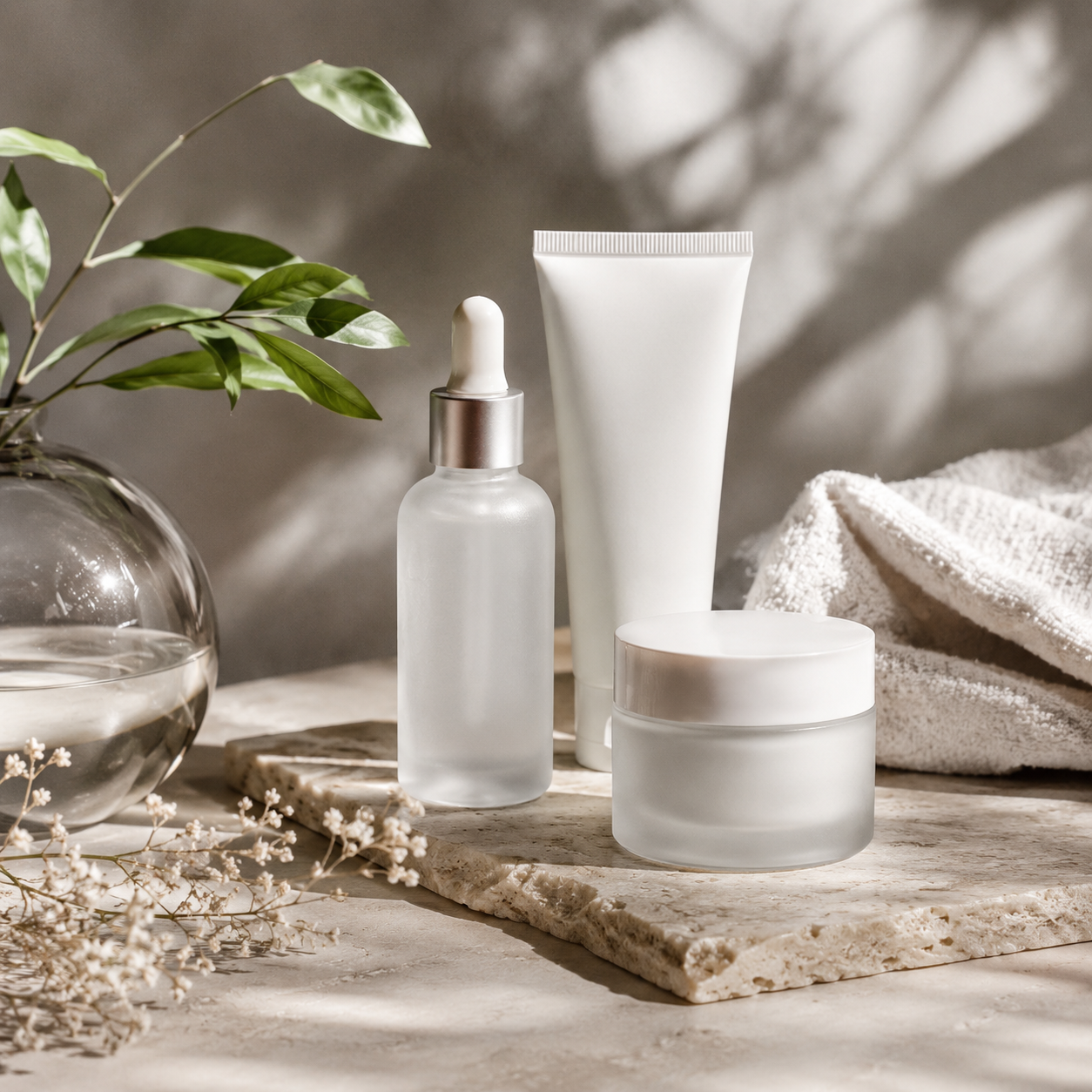
If you're a clinic, a salon, an influencer with an audience, or a founder with a formulation idea, the barrier to entry is genuinely low now. You don't need a lab. You don't need a factory. What you need is a GMP-certified manufacturing partner who can take you from idea to a compliant, sellable product without letting you make the expensive mistakes. Here's how that actually goes — for brands building specifically for the Singapore market and beyond.
Your Brand Decides Your Formula, Not the Other Way Around
Founders usually arrive excited about an ingredient. "I want a niacinamide serum." "I want something with bakuchiol." That's the wrong end to start from.
Niacinamide at 5% in a lightweight essence and niacinamide at 10% in a rich cream are two different products for two different customers at two different price points. The ingredient doesn't tell you which one to build. Your customer does.
Before we talk chemistry, we ask clients four questions:
- Who buys this, specifically? Not "women 25–45" — that's everyone. A resurfacing acid for oily, acne-prone skin in a humid climate is a real customer.
- What are they paying for it, and where? A $19 Shopee cleanser and a $79 clinic-dispensed serum have completely different formulation budgets.
- What are they using now, and why would they switch?
- Does this fit what you already sell? A clinic adding a post-procedure recovery cream has a natural customer. A clinic adding a men's beard oil does not.
Segments that work well as a starting point: sensitive and barrier-repair, active acne, brightening for pigmentation (a large concern in this region), post-procedure recovery for clinics, and clean or minimalist formulations. The brands that struggle are the ones trying to serve all of these at once.
Register the Business Before You Register the Product
One step that trips up first-time founders: HSA notification isn't the first thing that needs to happen — company registration is. Cosmetic product notifications in Singapore can only be submitted by a locally registered entity, typically a Pte Ltd company registered with ACRA (the Accounting and Corporate Regulatory Authority). If you're planning to sell under a Singapore-registered brand, get this sorted before you're deep into formulation — your manufacturer will need your registered entity details to prepare notification documentation on your behalf.
Private Label, White Label, ODM, or OEM — Pick Based on Time and Money, Not Prestige
There's a myth that "custom" is the serious choice and private label is for amateurs. It isn't. Each model is a trade between speed, cost, and originality — and the terms get used loosely, so it's worth being precise about what each actually means.
Private label (sometimes called white label) is our existing formulation, your branding — with the option of light customisation such as fragrance or a signature active. It's the fastest route to market — often weeks, not months — and it's the right choice for testing whether you can sell anything at all before you spend on R&D. Strictly speaking, "white label" refers to a ready-made product rebranded with no formula changes, while "private label" allows some customisation — in practice, most Singapore manufacturers (including us) use the terms close to interchangeably, so ask specifically what level of customisation is included.
ODM starts from a proven base formula and adjusts it — texture, fragrance, a signature active, the finish. You get something recognisably yours without paying for ground-up development. This is where most first-time brands should sit.
OEM is a formula built for you from scratch, or manufactured exactly to a formula you already own. Real differentiation, real IP, but real cost and time too. Worth it when you know your market and need something that doesn't exist yet — not for a first product where you're still guessing what customers want. Our manufacturing guide breaks down the cost and timeline differences between all three models in more detail.
A pattern we see: brands that go straight to full OEM for product one often sink significant time and budget into developing something the market then rejects, simply because there was no earlier, cheaper step to test demand first. Starting with ODM or private label lets the market tell you what to build before you pay to build it.
Launch Two Products, Not Ten
A ten-SKU launch feels ambitious. In practice, it means ten formulations to fund, ten sets of packaging to order at minimum quantities, ten things to photograph and write copy for, and ten guesses about demand — most of which will be wrong.
Two or three hero products are enough to open a brand. A cleanser and a treatment serum. A serum and a moisturiser. You learn which one actually sells, you build a customer base, and you expand into what that base is asking for rather than what you assumed they'd want. The expansion is cheaper and lower-risk because it's demand-led.
Common opening line-ups that work: a cleanser plus a hero serum; a single problem-solving treatment (acne, pigmentation) sold on results; or a post-procedure pairing for clinics.
What a Good R&D Team Actually Saves You From
Choosing trending actives is the easy part. The work that separates a product that sells once from one that gets reordered is the unglamorous part: does the emulsion hold together at Singapore's ambient temperature and humidity? Does the vitamin C oxidise and turn brown in three months on a shelf? Does the "clinical" concentration of an acid actually pass a patch test, or does it just generate returns and one-star reviews?
A real R&D team earns its keep by telling you no. No, you can't put that many actives in one serum and expect it to stay stable. No, that fragrance won't survive the preservative system. No, that active is fine, but it needs airless packaging, or it degrades. Stability testing, compatibility, preservation, sensory feel — this is where products are actually won or lost, and it happens before a single unit ships.
Often the better formulation is the one with fewer ingredients, not more. An overloaded "everything serum" tends to be less stable, more irritating, and harder to make claims about than a focused one that does one thing well. Our custom formulation team works through exactly this trade-off with every new brief.
Ingredients: Match Them to the Concern, in This Climate
Consumers now read ingredient lists and Google actives before buying, so the formulation has to hold up to scrutiny. But the goal isn't to load in whatever's trending — it's to solve the concern for the person who lives in this climate.
Regionally relevant choices worth knowing: niacinamide and tranexamic acid for the pigmentation concerns common in Southeast Asian skin; lightweight hydrators like hyaluronic acid and panthenol that suit humidity better than heavy occlusives; salicylic acid for the oily, congestion-prone skin the climate produces; ceramides and centella for barrier repair, especially post-procedure; and bakuchiol as a gentler alternative to retinol for sensitive users.
The useful question in formulation isn't "what's popular" — it's "which of these work together to fix this specific concern, and which are just marketing weight."
Packaging Is a Formulation Decision, Not a Decoration
Packaging protects the formula, sets the first impression, and quietly determines your shipping costs and margins. It also interacts with chemistry: an antioxidant serum in a clear glass dropper bottle will degrade in light and air, no matter how good the formula is. Some actives need airless pumps. Some need opaque or UV-blocking material.
Things to decide early, because they affect cost and stability: bottle versus jar versus airless; dropper versus pump; glass versus PET. Premium glass photographs beautifully and lifts perceived value — it also raises shipping weight, breakage rates, and cost per unit, which matters a lot if you're selling online at volume. High-grade PET often gives you most of the look at a fraction of the logistics cost. The right answer depends on your channel and price point, not on what looks best on a moodboard.
Singapore's Cosmetic Regulations, in Plain Terms
Cosmetic products supplied in Singapore are regulated by the Health Sciences Authority (HSA) under the Health Products (Cosmetic Products — ASEAN Cosmetic Directive) Regulations 2007, which closely mirror EU cosmetics regulation. In practice, that means before you sell, your product typically needs to be notified to HSA through their online PRISM (Pharmaceutical Regulatory Information System) portal — which first requires registering a CRIS (Client Registration and Identification Service) account tied to your ACRA-registered entity.
There's no pre-market approval process like a drug — HSA doesn't test or certify your product before you sell it. The responsibility sits entirely with the company placing the product on the market (referred to as the "Responsible Person") to ensure it's safe, correctly labelled, and free of banned or restricted substances under the ASEAN Cosmetic Directive annexes. Notifications are valid for one year and require annual re-notification to keep selling.
Manufacturing under ISO 22716 (cosmetic GMP) matters here because it's the recognised standard for consistent, documented, compliant production — which is exactly what a notification, and any later HSA safety inquiry, relies on having in place. Ask any manufacturer you're considering for their actual certificate number, not just a claim of being "GMP-certified." See our full regulatory updates page for how these requirements are shifting across export markets too.
Ordering too much too early is how new brands die. Cash goes into inventory, the product doesn't move as fast as hoped, and there's no money left to market the stock sitting in a warehouse. A low minimum order quantity lets you launch, measure real demand, and reorder based on what's actually selling. It's not thinking small — it's refusing to bet the business on an untested guess.
What Low MOQ — and Realistic Launch Cost — Actually Look Like
To make this concrete rather than vague, here's what our own production minimums typically look like for a first-time brand:
- Private label products: from 100 to 500 units per SKU.
- Custom OEM/ODM formulations: from 500 to 1,000 units per SKU, subject to product type and packaging.
- Reorders: once your product has launched, repeat orders are typically completed within 6–8 weeks, depending on raw material availability and packaging lead times.
On total launch budget: industry-wide, first-product launches for a small independent brand commonly range from a few thousand dollars for a lean private label run up to the tens of thousands for a fully custom OEM line with premium packaging and a multi-SKU launch — the model you choose (private label vs. ODM vs. OEM) is usually the single biggest lever on where you land in that range. See our pricing guide for how to work backwards from your retail price to a viable production budget.
This flexible approach lets brands launch with lower upfront investment and scale production as demand actually materialises, rather than as a bet made before day one.
Sort Out How You'll Sell Before Production Finishes
Manufacturing is the middle of the process, not the end. Where and how you sell should be decided before the stock arrives, because it changes the product itself — pack size, price point, even formulation.
Online marketplaces (Shopee, Lazada, TikTok Shop) and your own site drive volume and reach. Clinics and salons drive credibility and margin — a product dispensed by a professional carries trust an ad can't buy, and often supports a higher price. Most brands end up combining channels, but they serve different jobs: marketplaces for scale, professional channels for authority. A serum built for a $25 marketplace price and one built for a $75 clinic shelf are not the same product, so this decision comes first.
Marketing Starts Before the Product Exists
We've watched genuinely good products fail because nobody knew they existed. The launch is not the starting line for marketing — it's roughly the midpoint.
Educational content is the channel that compounds: ingredient explainers, concern-based guides, honest comparisons. It helps customers decide, and it builds search visibility over months so that by the time you launch, you're already ranking for the questions your buyers ask. Paid social and Google Ads buy immediate reach; influencer and professional endorsement buy trust; sampling gets the product onto skin. But the SEO groundwork has to start early, because it's the slowest to pay off and the hardest for a competitor to buy their way past.
The Mistakes We See Most
- Too many products at launch. More SKUs, more cost, more risk, less focus. Almost always the wrong call for a first launch.
- Competing on price alone. Cheap acquisition means nothing if the product doesn't earn a second purchase. Reorder rate is the number that decides whether a brand lives.
- Branding that blurs. Buyers compare a dozen options. A brand that isn't clearly for someone gets skipped, however good the formula.
- Zero marketing budget. A great product with no distribution and no awareness is a warehouse full of stock.
- Picking the wrong manufacturer. The cheapest quote is not the cheapest partner. Poor communication, weak R&D, and inconsistent quality cost far more in delays, failed batches, and lost customers than a slightly higher unit price ever would — see our guide on choosing the right manufacturing partner for what to actually check before signing.
Working With TX Labs
We run OEM, ODM, and private label out of one house, so the right model for your budget and timeline is a conversation, not a constraint. Our R&D team works with clinics, dermatology practices, retailers, and first-time founders, and we'd rather talk you out of an over-ambitious first launch than sell you one that fails.
A beauty brand initially approached TX Labs to develop a premium skincare formulation using several high-cost active ingredients. After reviewing the product concept and understanding the client's objectives, our R&D team recommended an alternative combination of ingredients that delivered similar performance while improving formulation stability and reducing manufacturing costs. The result was a high-quality product that met the client's performance expectations while staying within budget — a better balance between product quality and commercial viability than the original brief would have achieved alone.
What we handle: custom formulation, ODM and private label development, stability testing, packaging selection, regulatory and notification support, and low-MOQ production so you can start without over-committing cash. Curious what we make? See our skincare, hair care, and personal care product pages.
If you're planning a skincare brand in Singapore, tell us what you're trying to build and who it's for. We'll tell you the honest path to get it made — including when the honest answer is "start smaller."
✛ Frequently Asked Questions
Quick Answers
How much does it cost to start a skincare brand in Singapore?
It depends heavily on the model. A lean private label launch can start in the low thousands of dollars; a fully custom OEM line with premium packaging can run into the tens of thousands. Private label is the lowest-cost route since the formulation already exists — your main costs are packaging, branding, and minimum order quantity. ODM and OEM add formulation development cost on top, which scales with how customised the formula needs to be.
What's the minimum order quantity (MOQ) for a skincare brand in Singapore?
At TX Labs, private label typically starts from 100–500 units per SKU, and custom OEM/ODM formulations from 500–1,000 units per SKU, depending on product type and packaging. Reorders are typically ready within 6–8 weeks.
Do I need to register a company before I can sell skincare in Singapore?
Yes — cosmetic product notifications to HSA can only be submitted by a locally registered entity, typically a Pte Ltd company registered with ACRA. It's worth handling company registration early, in parallel with formulation, rather than waiting until the product is ready.
Do I need HSA approval to sell skincare products in Singapore?
You need to notify HSA through the PRISM portal before selling — this isn't a pre-market approval or certification, but you as the "Responsible Person" are still fully responsible for the product's safety, correct labelling, and compliance with ASEAN Cosmetic Directive ingredient restrictions. Notifications are valid for one year and require annual re-notification.
What's the difference between private label, white label, ODM, and OEM?
White label is a ready-made product rebranded with no formula changes. Private label is similar but usually allows light customisation (fragrance, a signature active). ODM starts from a proven base and customises it further to your brief. OEM builds a fully custom formula from scratch or manufactures exactly to a formula you already own. Most first-time brands are best served by ODM or private label.
What does "GMP-certified" actually mean for a skincare manufacturer?
GMP (Good Manufacturing Practice) for cosmetics in Singapore and the wider ASEAN region means certification to ISO 22716, the recognised standard for consistent, documented, compliant production. Ask any manufacturer for their actual certificate number rather than taking a general claim at face value.
Ready to Start Your Skincare Brand?
Tell us what you're trying to build and who it's for — we'll map the honest path to get it made, including the right model, MOQ, and timeline for your budget.
Contact TX Labs WhatsApp UsFOR FASTER RESPONSE